
Dermato Surgery in Jaipur: Safe, Precise Skin Procedures by Expert Dermatosurgeons
Precision minor skin surgery by board-certified dermatologists in Jaipur. Mole removal, cyst excision, Jodhpur vitiligo grafting, fat grafting, and ingrown toenail PNA. Supervised directly by Senior Dermatologists Dr. U.S. Agarwal (Ex. Principal SMS Medical College) & Dr. Puneet Agarwal (Associate Professor, SMS Hospital).
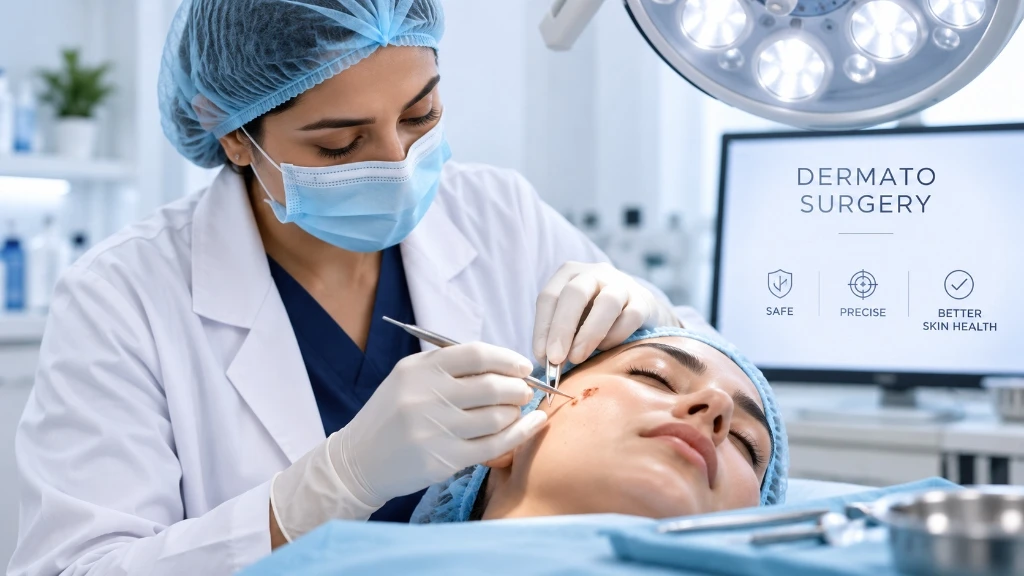
Quick Facts: Dermato Surgery
US-FDA VerifiedDermato Surgery in Jaipur: Safe, Precise Skin Procedures by Expert Dermatosurgeons
If you have been searching for dermato surgery in Jaipur to remove a stubborn mole, treat a cyst, correct a scar, or deal with a skin growth that has been bothering you for months, you do not have to live with it any longer. Dermato surgery, also called surgical dermatology, is a specialised branch of skin care where a trained dermatologist uses small, precise procedures to treat conditions of the skin, hair, and nails. These are usually quick, day-care procedures with local anaesthesia, minimal discomfort, and a fast return to normal life.
Not all dermatological concerns can be resolved with topical prescriptions, peels, or non-invasive energy devices. Structural lesions, resistant growths, atrophic deficits, and pigmentary loss demand surgical intervention.
Dermatosurgery is a subspecialty of dermatology focused on the diagnosis, excision, and reconstructive repair of the skin, hair, and nails. Unlike general surgery, dermatosurgery is built on the twin pillars of complete pathological clearance and optimal cosmetic outcome, ensuring minimal scarring, preserved tissue architecture, and zero-to-low downtime.
At Sundaram Jaipur Laser Clinic, all minor surgical and reconstructive procedures are performed in a sterile, state-of-the-art operative suite directly by board-certified dermatologists Dr. U.S. Agarwal (Ex-Principal, SMS Medical College) and Dr. Puneet Agarwal (Associate Professor, SMS Hospital). From precise skin lesion excisions to complex melanocyte transfers and micro-fat grafting, every intervention is planned using anatomical precision tailored to Indian skin.
What Is Dermato Surgery (Surgical Dermatology)?
Dermato surgery is the part of dermatology that focuses on treating skin conditions through minor surgical and procedural techniques. Unlike major operations performed in an operating theatre under general anaesthesia, most dermatosurgical procedures are done in a clinic setting in a short time, using local anaesthesia so that you stay awake and comfortable.
A dermatosurgeon is a dermatologist with additional training in surgical techniques, skin anatomy, wound healing, and cosmetic outcomes. That combination matters, because the goal is not only to treat the problem but also to leave the skin looking as natural and healthy as possible.
💡 In simple words: it is medical treatment and aesthetic care in one place. You get the safety of a medical procedure with the finesse of skin-focused cosmetic planning.
Meet Your Dermatologists
Skin treatments can look simple, but choosing the right technology, excision plane, and suture setting takes deep medical judgment.
Dr. U.S. Agarwal
Senior Dermatologist | Ex-Principal & Senior Professor, SMS Medical College
Decades of clinical, surgical, and teaching experience across Rajasthan. Pioneered clinical laser dermatology, vitiligo grafting, and dermatosurgical protocols with a careful, safety-first approach to every treatment plan.
Dr. Puneet Agarwal
Senior Dermatologist & Dermatosurgeon | Associate Professor, SMS Hospital
Combines academic excellence with hands-on practice in surgical dermatology and aesthetics. Gold Medalist in MD Dermatology, specializing in minimal-incision cystectomies, Jodhpur vitiligo technique, nail matrixectomies, and scar revisions.
Comprehensive Minor Dermatosurgical Spectrum
Our clinic provides targeted surgical management for benign growths, infectious lesions, metabolic deposits, and structural lesions:
1. Excision & Biopsy
- Epidermoid & Sebaceous Cysts
- Subcutaneous Lipomas
- Full-Thickness Dysplastic Moles
- Diagnostic Punch & Shave Biopsies
2. Aesthetic Lesions
- Periorbital Xanthelasma Removal
- Sterile Milia Enucleation
- Advanced Scar Revision & Subcision
- Stitchless & Micro-Suture Earlobe Repair
3. Infectious & Nail Growths
- Viral Warts (Radiofrequency Ablation)
- Molluscum Contagiosum Curettage
- Ingrown Toenails (PNA + Matrixectomy)
- Seborrheic Keratoses & Acrochordons
Targeted Surgical Procedures: Indications & Surgical Approaches
Mole Excision (RF & Surgical Excision)
Indications: Dysplastic, elevated, symptomatic, or cosmetically undesirable intradermal or junctional nevi.
RF Elliptical Shave: High-frequency radiowaves vaporize superficial lesions flush with surrounding skin with instant capillary coagulation—leaving no scalpel sutures.
Full-Thickness Elliptical Excision: For deep nevi. Performed strictly along Relaxed Skin Tension Lines (RSTLs) and closed with layered micro-sutures for an imperceptible scar.
Sebaceous & Epidermoid Cyst Excision
Indications: Subcutaneous nodules containing keratinous debris and lipids on scalp, face, neck, or back.
Surgical Approach: Unlike simple lancing (which leaves the capsule intact and leads to high recurrence), our dermatologists perform complete removal of the cyst wall via a micro-puncture made by radiofrequency cautery or minimal-incision cystectomy, minimizing recurrence.
Lipoma Removal (Enucleation & Micro-Incision)
Indications: Benign, encapsulated subcutaneous adipose tumors.
Surgical Approach: Using modified squeeze-delivery or micro-incision enucleation, the lipoma is mobilized away from underlying fascial attachments and expressed through a small, hidden incision under local tumescent analgesia, preventing long scars and tissue trauma.
Milia Extraction
Indications: Tiny, pearl-like subepidermal keratin cysts clustered around the periorbital and malar regions.
Surgical Approach: Milia lack open pore exits and cannot be squeezed like acne. Under sterile optical magnification, a micro-gauge needle creates an aperture to gently enucleate the calcified keratin core without epidermal tearing or post-inflammatory marks.
Radiofrequency (RF) Ablation for Viral Warts
Indications: Verruca vulgaris, periungual warts, and filiform facial warts caused by HPV.
Surgical Approach: Monopolar and bipolar radiofrequency ablatotherapy delivers micro-oscillating energy that dehydrates verrucous cells and cauterizes the feeding capillary base with micron control—drastically lowering recurrence compared to standard cryotherapy.
Molluscum Contagiosum Extraction
Indications: Umbilicated, contagious viral papules caused by poxvirus (pediatric and adult).
Surgical Approach: Using a sterile sharp curette under topical anesthetic cream occlusion, the central umbilicated viral core (molluscum body) is cleanly expressed. Targeted chemical cautery prevents autoinoculation and spread.
Xanthelasma Palpebrarum Removal
Indications: Sharply demarcated, yellowish plaques of cholesterol-laden histiocytes on eyelids.
Surgical Approach: Because eyelid skin is delicate, aggressive cutting risks ectropion (eyelid eversion). Our clinicians combine precise chemical cautery or ultra-fine micro-RF ablation to clear deposits while preserving ocular margins.
Diagnostic Skin Biopsy (Punch, Shave & Incisional)
Indications: Confirmation for atypical rashes, autoimmune dermatoses (Lichen Planus, Lupus), blistering diseases, and suspected skin neoplasms.
Surgical Approach: Under sterile local anesthesia, a 3 mm to 5 mm punch or precision scalpel blade harvests a full-thickness sample (epidermis, dermis, fat) for histopathology or Direct Immunofluorescence (DIF), closed with micro-sutures.
Advanced Scar Revision
Indications: Hypertrophic, jagged, wide, or tethered facial scars resulting from prior trauma, acne, or poorly sutured wounds.
Surgical Approach: Multi-modality subcision and microneedling combined with ablative Fractional CO2 laser resurfacing to release fibrotic dermal tethers, level uneven contours, and promote organized collagen remodeling.
Surgical Vitiligo Management: Restoring Pigment to Stable Patches
Vitiligo surgery is reserved for patients whose patches have demonstrated absolute clinical stability (no new lesions, no enlargement of existing lesions, and no Koebner phenomenon for at least 6 to 12 months) and have proved refractory to medical therapies.
Vitiligo surgeries harvest healthy autologous melanocytes from a normally pigmented donor zone (typically the lateral thigh or gluteal region) and transplant them into the de-epithelialized vitiliginous recipient bed.
1. Miniature Punch Grafting (MPG)
Small circular punch grafts (1.0 mm to 1.5 mm) are harvested from pigmented skin and placed into recipient chambers spaced 3 mm to 4 mm apart.
Repigmentation: Within 4 to 8 weeks, melanocytes migrate outwards in a radial "perigraft halo" to bridge depigmented gaps. Dependable for small or acrofacial patches.
2. Split-Thickness Skin Grafting (STSG)
A precision dermatome harvests an ultra-thin epidermal sheet containing the basal cell layer. The recipient bed is abraded to the pinpoint capillary bleeding plane, and the sheet is secured with biological adhesive.
Clinical Result: Rapid, uniform, and cosmetically seamless repigmentation without cobblestoning, ideal for flat facial and body patches.
3. The Jodhpur Technique
A non-cultured dermal-epidermal scraping technique that avoids costly laboratory incubation, making cellular melanocyte transfer accessible and efficient.
- Zero cobblestoning risk
- No expensive trypsinization/enzymes
- High 1:3 to 1:5 expansion ratio
Step-by-Step Surgical Execution of The Jodhpur Technique
- Step 1: Donor Site HarvestingA small split-thickness donor graft is harvested from the anterolateral thigh under local anesthesia.
- Step 2: Cellular ScrapingUsing a sterile scalpel blade on a glass surface, the dermal-epidermal junction is scraped into a fine, cell-dense slurry containing viable melanocytes, keratinocytes, and growth factors.
- Step 3: Recipient Bed PreparationThe vitiliginous patch is deepithelialized using precision surgical dermabrasion or CO2 laser until pinpoint capillary dew drops appear.
- Step 4: Implantation & Bolster BandageThe slurry is spread over the recipient bed, secured with biological tissue glue, and immobilized under a bolster pressure dressing for 7 days.
Autologous Fat Grafting (Micro-Fat & Nano-Fat) for Atrophic Scars
Atrophic, bound-down scars—whether caused by severe cystic acne, chickenpox, trauma, or previous surgical incisions—involve loss of structural volume in the subcutaneous fat compartment alongside fibrotic tethering. While topical retinoids and superficial lasers address epidermal texture, they cannot restore missing structural adipose tissue.
Micro-Fat Grafting
Deep Volumetric LiftPurified fat is processed through 1.2 mm to 1.4 mm micro-cannulas, retaining intact structural adipose lobules.
- Injected into deep subcutaneous fat compartments
- Restores lost volume under hollow, dish-shaped rolling scars
- Acts as a physical spacer preventing fibrotic scar re-tethering
Nano-Fat Grafting
Stem-Cell RegenerationMechanically emulsified through micro-fluidic mesh connectors (400–600 microns) to release pure Adipose-Derived Stem Cells (ADSCs) and growth factors.
- Injected into superficial dermis via fine 30G needles
- Secretes high concentrations of VEGF, HGF, and TGF-β
- Induces neo-angiogenesis and normalizes scar dyspigmentation
Ingrown Toenails (Onychocryptosis): Pathology & Surgical Management
An ingrown toenail occurs when the lateral or medial edge of the nail plate pierces into the surrounding periungual soft tissue, leading to foreign-body inflammatory cascades, chronic bacterial infection, hyper-granulation tissue formation ("proud flesh"), and debilitating pain.
| Stage of Onychocryptosis | Clinical Presentation | Recommended Medical Action |
|---|---|---|
| Stage 1 (Mild) | Mild erythema, localized edema, and pressure tenderness. | Conservative warm soaks & cotton wisp technique |
| Stage 2 (Moderate) | Marked inflammation, seropurulent discharge, and infection. | Partial Nail Avulsion with Chemical Matrixectomy |
| Stage 3 (Severe / Chronic) | Exuberant granulation tissue ("proud flesh") covering nail plate. | Definitive PNA + 88% Phenol Matrixectomy |
Primary Causes:
- • Improper Trimming: Rounding edges leaves sharp nail spikes (spicules).
- • Constrictive Footwear: Narrow pointed shoes compress the lateral fold.
- • Direct Trauma: Football, running, or anatomical pincer nail deformity.
- • Anatomy: Abnormally wide nail plates or hypertrophic nail folds.
Caution on Home Remedies:
If yellow discharge, persistent bleeding, throbbing rest pain, or exuberant red granulation tissue emerges, stop home remedies immediately. Continuing to dig at the nail risks deep tissue cellulitis and bone infection (osteomyelitis).
Partial Nail Avulsion (PNA) with 88% Chemical Phenol Matrixectomy
The definitive dermatological cure for recurrent Stage 2 and Stage 3 ingrown toenails:
- 1. Digital Ring BlockLocal anesthetic (plain 2% lignocaine) is infiltrated at the base of the toe, numbing the digit completely while you remain awake and pain-free.
- 2. Longitudinal SplittingUsing a sterile nail elevator, only the offending lateral 15% to 20% strip is split longitudinally from free edge down under the eponychial fold.
- 3. Spike ExtractionThe offending strip is removed cleanly, extracting the sub-ungual germinal horn without damaging the remaining 80% of healthy nail.
- 4. Granulation DebridementHypertrophic proud flesh is curetted away to relieve tissue pressure and eliminate bacterial reservoirs.
- 5. Chemical Matrixectomy88% Liquefied Phenol is applied into the lateral matrix horn for three cycles of 30–60 seconds, destroying germinal cells that create the spike.
- 6. Neutralization & DressingThe cavity is flushed with 70% isopropyl alcohol and dressed with an antibacterial bandage. Patients walk out immediately.
Why Partial Nail Avulsion (PNA) is Superior to Total Nail Extraction
Historically, general surgical clinics pulled the entire nail off. Modern dermatological science has rendered that approach obsolete:
| Clinical Metric | Whole Nail Avulsion (Outdated Approach) | PNA + Phenol Matrixectomy (Our Method) |
|---|---|---|
| Recurrence Rate | High (Up to 70–80%): Regrowing nail pierces the deformed fold again. | Extremely Low (< 2–5%): Problem germinal matrix is destroyed. |
| Cosmetic Appearance | Poor; causes nail dystrophy, ridging, narrowing, or thick deformed plates. | Normal Cosmetic Profile: 80–85% of natural nail remains intact. |
| Post-Operative Pain | Severe throbbing pain for 1–2 weeks due to raw, fully exposed nail bed. | Minimal: Intact nail plate shields the bed; resolves in 24–48 hours. |
| Downtime & Mobility | Extended; painful walking for weeks until raw bed epithelializes. | Rapid: Walk out immediately; resume regular shoes in 2–4 days. |
Is Dermato Surgery Safe?
When performed by a qualified dermatologist in a hygienic setting, minor dermatosurgical procedures have a strong safety record. Every procedure carries some risk, such as temporary swelling, bruising, infection, or scarring, but careful planning, sterile technique, and good aftercare keep these risks low. Your doctor will discuss the risks specific to your procedure before you consent, so you can decide with full information.
How to Choose the Best Dermatosurgeons in Jaipur
Whether you are comparing options for the best dermatosurgeons in Jaipur or the best doctors for surgical dermatology, these points help you decide with confidence:
Why Patients Trust Sundaram Jaipur Laser Clinic
Choosing a doctor for a procedure on your skin is a decision built on trust. Here is what patients appreciate about their care with us:
Specialist-Led Treatment
Your care is planned and performed directly by board-certified dermatologists, not delegates.
Honest Guidance
We recommend a surgical procedure only when it is truly medically or cosmetically indicated.
Comfort-Focused Approach
Gentle technique, targeted local anesthesia, and patient-friendly explanations ensure a painless session.
Clean, Hygienic Environment
Sterile operative instruments, disposable punch blades, and modern hospital-grade infection control.
Aesthetic Focus
We care deeply about how your skin looks after healing—aligning incisions with natural skin tension lines.
Clear Communication & Pricing
You always know what will be done, what it costs, and what healing timeline to expect before beginning.
Book Your Dermato Surgery Consultation in Jaipur
Your skin deserves careful, expert attention. If you are ready to explore dermato surgery in Jaipur with a medical team that values safety, clarity, and natural-looking results, we would be glad to help. Come in for a consultation, ask every question you have, and leave with a clear, personalized plan.
Transparent Treatment Pricing Breakdown
Dermato Surgery
| Body Area / Procedure | Single Session | 6-Session Package | Duration | Action |
|---|---|---|---|---|
| Skin Tag / RF Mole Removal (Per Unit) | ₹1,499 | ₹3,999Best Value | 20 Mins | Book |
| Epidermoid / Sebaceous Cyst Removal | ₹3,999 | ₹7,999Best Value | 30 Mins | Book |
| Partial Nail Avulsion (Ingrown Toenail) | ₹4,999 | ₹4,999Best Value | 35 Mins | Book |
| Stable Vitiligo Jodhpur Scraping / Grafting | ₹5,999 | ₹14,999Best Value | 60 Mins | Book |
Dermato Surgery Results

RF Mole & Skin Tag Removal
RF Mole & Skin Tag Removal
Supervised by Lead Dermatologists

Dr. U.S. Agarwal (डॉ. यू.एस. अग्रवाल)
- MD Dermatology, Venereology & Leprology
- MBBS — SMS Medical College & Hospital (Jaipur)
- Ex. Principal & Controller — SMS Medical College & Hospital, Jaipur
- Ex. Senior Professor & HOD — Department of Dermatology, SMS Hospital
- Pro Vice Chancellor — NIMS University
- Director & HOD — Department of Dermatology, NIMS Hospital & Medical College

Dr. Puneet Agarwal (डॉ. पुनीत अग्रवाल)
- MD Dermatology, Venereology & Leprology (Gold Medalist)
- MBBS — SMS Medical College & Hospital (Jaipur)
- Associate Professor, Department of Dermatology (SMS Hospital, Jaipur)
Frequently Asked Questions About Dermato Surgery in Jaipur
Get quick answers to common queries about laser treatments at Sundaram Jaipur Laser Clinic.

Still have questions?
Talk to our experts for personalized guidance.