
Hair Restoration in Jaipur: Medical Science, Hair Biology, and Tailored Advanced Therapies, Regenerative Biologics, and Lifestyle Medicine for Men & Women
Looking for a hair transplant in Jaipur? Dermatologist-led hair restoration with natural-looking results and transparent pricing. Supervised by Dr. U.S. Agarwal and Dr. Puneet Agarwal. Supervised directly by Senior Dermatologists Dr. U.S. Agarwal (Ex. Principal SMS Medical College) & Dr. Puneet Agarwal (Associate Professor, SMS Hospital).
Quick Facts: Hair Restoration & Transplant
US-FDA VerifiedHair Restoration in Jaipur: Medical Science, Hair Biology & Advanced Therapies
If you are looking for the best hair transplant in Jaipur, the first question on your mind is probably the price, and the second is whether a lower price means lower quality. Both are fair concerns. A hair transplant is a one-time investment in something you will wear on your head for life, so the goal is not the cheapest quote. It is the best value for a safe, natural result.
Hair thinning and sudden shedding can be deeply distressing, yet navigating over-the-counter shampoos, dietary supplements, and salon oils rarely yields meaningful results. Hair loss is fundamentally a medical issue that demands an accurate diagnosis based on follicular biology.
At Sundaram Jaipur Laser Clinic, hair restoration begins with clinical trichology. Supervised by board-certified dermatologists, our diagnostic and therapeutic protocols target the cellular root of hair disorders—distinguishing temporary shedding from progressive miniaturization to deliver long-term, measurable hair density.
What Is a Hair Transplant?
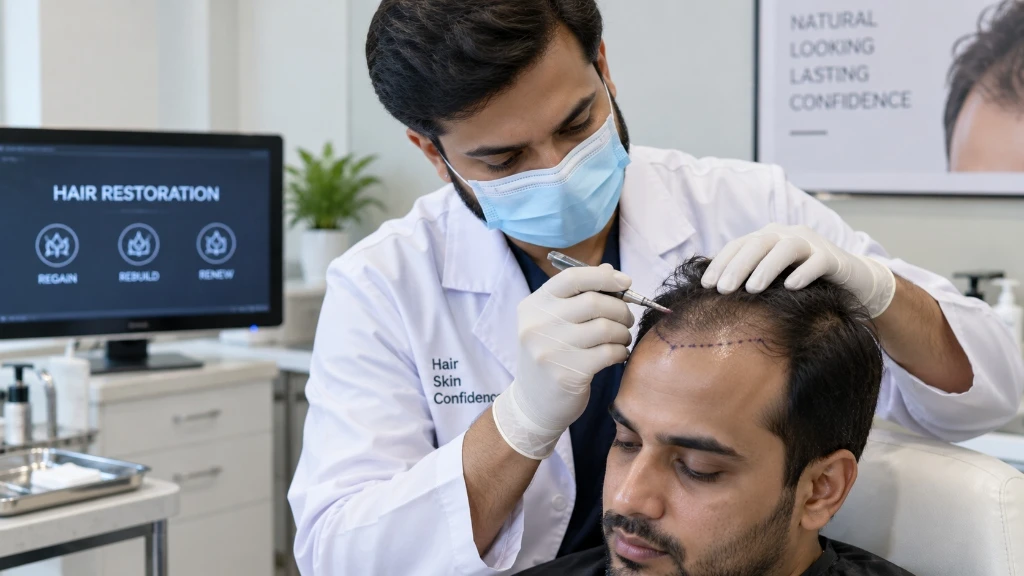
A hair transplant moves healthy hair follicles from a donor area, usually the back of the scalp (occipital zone), to thinning or bald areas. Donor follicles are genetically resistant to the hormone behind pattern baldness (DHT), so they keep growing after they are moved. Done well, the result is hair that looks, grows and styles like your own, because it is.
Hair restoration in Jaipur has advanced considerably, but results still depend heavily on the doctor's planning, the hairline design and careful handling of every graft.
Hair Transplant Cost in Jaipur: What Affects Price?
The hair transplant cost in Jaipur is not a fixed number. Key clinical variables include:
- • Number of grafts: Receding hairlines need fewer grafts than crown/vertex coverage.
- • Technique: Sapphire FUE requires meticulous microsurgical skill.
- • Donor quality & density: Thickness, caliber, and hair curl.
- • Doctor's personal involvement: Planning the hairline and executing key incisions.
- • Add-on biologics: GFC, PRP, or medical therapy to safeguard native hair.
The Biological Foundation: The Normal Hair Growth Cycle
To understand why hair sheds or stops growing, one must understand how a healthy follicle operates. Hair does not grow continuously; instead, each follicle cycles independently through three distinct phases:
- • 85–90% of scalp hairs
- • Lasts 2 to 7 years
- • Rapid cell division in dermal papilla bulb
- • Grows approximately 1 cm per month
- • 1–2% of scalp hairs
- • Lasts 2 to 3 weeks
- • Mitotic activity in the bulb ceases
- • Lower follicle detaches from dermal papilla blood supply
- • 10–15% of scalp hairs
- • Lasts 2 to 4 months (60–90 days)
- • Old club hair sheds as new anagen hair emerges
- • Losing 50–100 hairs/day is physiologically normal
When pathological disruptions shift hairs prematurely into the telogen phase or shrink the follicle diameter permanently, clinical alopecia develops.
Types of Alopecia: Non-Cicatricial vs. Cicatricial
Dermatologists classify hair loss into two broad clinical categories based on follicular viability:
- Follicular ostia preserved: Openings remain visible under trichoscopy.
- Follicles remain viable: Roots are alive and capable of revival.
- Reversible: Responds to medical therapy, GFC, and regenerative biologics.
- Examples: Male Pattern Baldness (MPB), Female Pattern Hair Loss (FPHL), Telogen Effluvium.
- Follicular ostia destroyed: Pores are erased and replaced by fibrotic scar tissue.
- Primary inflammatory damage: Stem cell niche in the bulge is permanently attacked.
- Irreversible: Primary clinical focus is urgent disease arrest to save remaining hair.
- Examples: Lichen Planopilaris (LPP), Frontal Fibrosing Alopecia (FFA), Discoid Lupus (DLE).
Hair Loss in Men: Telogen Effluvium vs. Male Pattern Baldness
The two most common causes of hair thinning in men require completely different management strategies:
| Parameter | Telogen Effluvium (TE) | Male Pattern Baldness (Androgenetic) |
|---|---|---|
| Underlying Mechanism | Acute systemic physiological shock (infection, fever, stress) | Follicle genetic sensitivity to Dihydrotestosterone (DHT) |
| Onset & Progression | Sudden, diffuse shedding occurring over weeks | Gradual, progressive miniaturization over months and years |
| Pattern of Loss | Uniform thinning across the entire scalp | Bilateral bitemporal recession (M-shape) and crown thinning |
| Follicle Status | Fully intact, normal hair caliber | Progressive follicular atrophy & thinning |
| Shed Hair Profile | Full-length club hairs with white bulb | Short, thin, wispy miniaturized hairs |
| Primary Focus | Trigger identification, stress mitigation & nutritional repletion | DHT inhibition, vascular vasodilators & in-clinic biologics |
Hair Loss in Females: Telogen Effluvium vs. Female Pattern Hair Loss
Female hair loss is multifactorial, frequently masked by overlapping nutritional deficiencies, metabolic shifts, and hormonal fluctuations:
Female Pattern Hair Loss (FPHL) & PCOS
Unlike male pattern baldness, FPHL rarely leads to complete baldness. It typically presents as diffuse miniaturization along the central parting line (the Ludwig Scale or “Christmas Tree” pattern), while preserving the frontal hairline.
Telogen Effluvium in Females
Women are particularly prone to acute and chronic telogen effluvium due to distinct physiological triggers:
- • Postpartum Telogen Effluvium: A steep drop in pregnancy estrogens sends millions of follicles into telogen simultaneously 3 to 4 months after childbirth.
- • Iron & Ferritin Deficiency: Serum ferritin under 40–50 μg/L deprives rapidly dividing matrix cells of oxygen, causing chronic shedding.
- • Thyroid Imbalances: Hypothyroidism or hyperthyroidism disrupts the hair cycling clock.
The Clinical Diagnostic Protocol at Jaipur Laser Clinic
Accurate diagnosis determines treatment success through our structured 4-step framework:
Digital Trichoscopy
High-magnification visualization. A shaft diameter variation greater than 20% objectively confirms miniaturization.
Modified Hair Pull Test
Standardized gentle traction across multiple scalp zones to quantify the exact percentage of active telogen shedding.
Targeted Blood Profiling
Ferritin, Vitamin D3, B12, TSH panel, Free Testosterone, DHEAS, LH:FSH ratio, and Fasting Insulin.
Multimodal Therapy Plan
Combining systemic hormonal/nutritional correction with regenerative in-clinic biologics (GFC, PRP, Dutaxosome).
The Metabolic Foundation: Nutrition, Lifestyle & Systemic Health
Hair follicles contain some of the most rapidly dividing cells in the human body. Because hair is non-essential for survival, systemic inflammation and nutritional deficits immediately divert nutrients away from hair roots.
1. The Follicular Diet
Bioavailable Protein: Hair shafts are 85% keratin (cysteine, lysine, methionine). Consume eggs, paneer, tofu, lentils, and Greek yogurt.
Iron & Ferritin: Essential for DNA synthesis in hair bulbs. Spinach, beetroot, pumpkin seeds paired with Vitamin C.
2. Scalp Micro-Circulation
Moderate cardio exercise (30–45 mins, 4–5 days/week) lowers cortisol, improves insulin sensitivity, and triggers endothelial nitric oxide release—pumping oxygen and nutrients directly into the scalp vascular plexus.
3. The Impact of Smoking
Nicotine causes terminal micro-capillary vasospasm, starving follicles of blood. Tobacco smoke concentrates reactive oxygen species (ROS) and upregulates circulating androgens, accelerating genetic hair loss.
Advanced In-Clinic Regenerative Procedures
When home remedies and oral supplements plateau, clinical interventions directly deliver concentrated biological signals to dormant hair papillae:
1. Scalp Microneedling
Automated micro-needles (0.5–1.5 mm) trigger wound repair, local PDGF release, and Wnt/β-catenin signaling while opening transdermal channels.
2. Autologous PRP
Centrifuged platelets release concentrated PDGF, VEGF, and EGF into the sub-follicular plane to stimulate cell proliferation and microvascular networks.
3. Growth Factor (GFC)
Proprietary activation tubes harvest pure, cell-free growth factors in high concentrations with zero RBCs/WBCs for minimal pain and superior efficacy.
4. Dutaxosome
Dual-action localized Dutasteride (Type I & II 5-AR inhibitor) paired with regenerative exosomes to halt DHT at the follicle root without systemic sexual side effects.
Platelet-Rich Plasma (PRP) vs. Growth Factor Concentrate (GFC)
| Feature | Platelet-Rich Plasma (PRP) | Growth Factor Concentrate (GFC) |
|---|---|---|
| Composition | Intact platelets suspended in plasma (contains RBC/WBC traces) | Acellular, pure released growth factors (completely cell-free) |
| Concentration | Variable based on patient biology | Uniform, high-potency standardized harvest |
| Post-Procedure Pain | Mild burning/pain from cellular inflammation | Minimal inflammation and virtually pain-free |
| Clinical Efficacy | Effective bio-stimulation | Superior, consistent follicular recovery |
The Role of Oral Collagen Supplementation in Hair Restoration
While topical collagen molecules are too large to penetrate the scalp barrier, low molecular weight hydrolyzed collagen peptides (< 3000 Daltons) offer measurable systemic support:
Meet Your Dermatologists
Hair transplant is a surgical procedure, and the doctor's skill decides the outcome. Hairline design, graft angle and donor planning cannot be hurried or delegated carelessly.
Dr. U.S. Agarwal
Senior Dermatologist | Ex-Principal, SMS Medical College
Decades of clinical and teaching experience, with a careful, safety-first approach to every treatment plan. Renowned across Rajasthan for clinical excellence in dermatology and hair disorder diagnostics.
Dr. Puneet Agarwal
Senior Dermatologist | Associate Professor, SMS Hospital
Combines academic experience with hands-on practice in hair and skin treatments, keeping surgical and regenerative protocols aligned with current medical standards.
How to Choose the Right Hair Transplant Clinic in Jaipur
Use this checklist when comparing clinics:
Confirm that a qualified doctor plans and personally performs the key surgical steps.
A reputable clinic investigates the medical root cause of hair loss first.
Beware of commercial guarantees of 100% density or “one-day miracle” claims.
The operating setting must be hospital-grade, clean, sterile, and professional.
Know exactly what is included (graft count, medications, post-care) before you begin.
Ask for genuine unedited before-and-after photographs and authentic patient feedback.
Ensure active dermatological follow-up and biological support are provided as grafts take root.
Looking for hair transplant near me in Jaipur? Convenience matters, but qualifications and honesty matter more. A consultation lets you meet the doctors and judge for yourself.
Recovery and Results Timeline
What to expect after your hair transplant procedure:
Mild redness, swelling, and small crusts form around transplanted grafts.
Scabs shed naturally. Transplanted hair shafts shed (shock loss - completely normal).
New fine anagen hair growth begins emerging from anchored roots.
Visible, substantial improvement in hair caliber, density, and scalp coverage.
Final, mature, permanent hair density with natural texture and styling capability.
Aftercare Tips for the Best Results
Why Patients Choose Sundaram Jaipur Laser Clinic
Trusted medical leadership with proven natural aesthetic results:
Book Your Hair Transplant Consultation in Jaipur
Your first step does not have to be a procedure. It can be a conversation. Book a consultation, and our dermatologists will examine your scalp, explain your options and give you a clear, personalized quote.
Transparent Treatment Pricing Breakdown
Hair Restoration & Transplant
| Body Area / Procedure | Single Session | 6-Session Package | Duration | Action |
|---|---|---|---|---|
| GFC / PRP Hair Growth Therapy (Per Session) | ₹2,999 | ₹14,999Best Value | 45 Mins | Book |
| Sapphire FUE Hair Transplant (1,500 Grafts) | ₹25,000 | ₹25,000Best Value | 5 Hours | Book |
| Sapphire FUE Hair Transplant (3,000+ Grafts) | ₹45,000 | ₹45,000Best Value | 7 Hours | Book |
| Dutaxosome / Exosome Follicular Therapy | ₹6,999 | ₹34,999Best Value | 60 Mins | Book |
Hair Restoration & Transplant Results

GFC & PRP Scalp Hair Density Growth
GFC & PRP Scalp Hair Density Growth
Supervised by Lead Dermatologists

Dr. U.S. Agarwal (डॉ. यू.एस. अग्रवाल)
- MD Dermatology, Venereology & Leprology
- MBBS — SMS Medical College & Hospital (Jaipur)
- Ex. Principal & Controller — SMS Medical College & Hospital, Jaipur
- Ex. Senior Professor & HOD — Department of Dermatology, SMS Hospital
- Pro Vice Chancellor — NIMS University
- Director & HOD — Department of Dermatology, NIMS Hospital & Medical College

Dr. Puneet Agarwal (डॉ. पुनीत अग्रवाल)
- MD Dermatology, Venereology & Leprology (Gold Medalist)
- MBBS — SMS Medical College & Hospital (Jaipur)
- Associate Professor, Department of Dermatology (SMS Hospital, Jaipur)
Frequently Asked Questions About Hair Transplant & Restoration in Jaipur
Get quick answers to common queries about laser treatments at Sundaram Jaipur Laser Clinic.

Still have questions?
Talk to our experts for personalized guidance.